



In almost every conversation I've had with association teams this year, they describe the same thing. Members show up for the annual meeting, then disappear. Or they log in to the LMS to finish their required CE, then leave until next year.
Nobody is doing anything wrong. That's just what happens when you design membership as a line.
The line we all drew
For a long time the member journey looked like this. Join, engage, renew. But joining and renewing aren't really separate stages. They're outcomes of what happens in the middle, and engage is where most of a member's experience actually lives. And that middle is exactly where the tech stack is most fractured. The LMS handled courses and credits. The community platform handled discussion. Each one did its job, and each one only saw its own slice of the member. So engagement, the glue that gives people a reason to join and leads them to renew, got split between them.
I know this line well, because I spent the past decade building LMS products on one stretch of it. My focus was solving one piece of the puzzle, education. And as it turns out, we could help organizations move engagement, but only so far. Even at their best, those learning experiences felt transactional and isolating. They couldn't reach one of the core reasons people join an association in the first place, which is to find shared purpose and belonging. And from the association's perspective, they were competing to solve a problem a for-profit CE provider could solve just as well. Check the box, earn the credit, log out.
That's what pushed me to ask how to truly break past that ceiling, and it's been my entire focus since joining Forj more than a year ago. It's something associations have always known, and it matters more now than ever. Almost no one moves through membership in a straight line. A member takes a course, asks a question in the community, answers someone else's question six months later, then comes back to learn something new because their job changed.
That's a loop, and when it's working, it's what makes an association the trusted source for industry leadership. Professionals have more options than ever, from for-profit CE providers to AI chat tools with sources they can't always trust to unofficial forums on WhatsApp and Reddit. None of them can offer what an association can, which is a trusted community of peers connected to the education members rely on. And when it's working, it meets each member where they are, in the moments that matter to them.
What changed
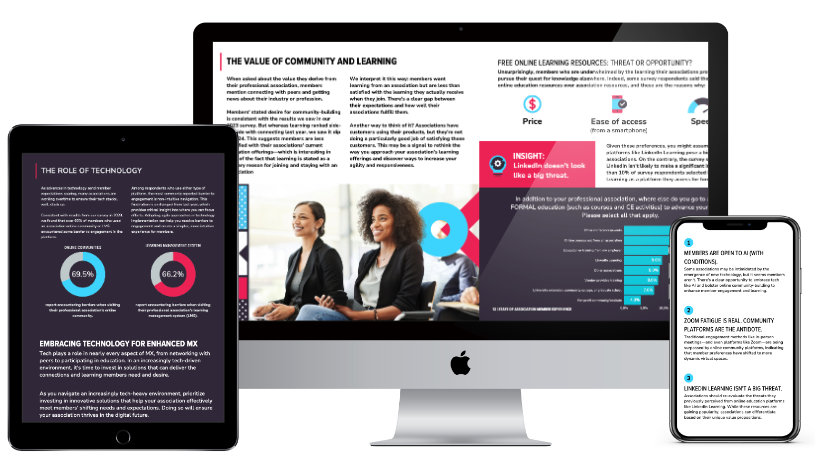
Each year, we survey association members and publish our State of Member Experience report. It isn't meant to reinforce our own narrative. It's a way for us, and the associations we work with, to take the pulse of how membership is changing. This year's findings are fascinating, and they show the pressure on the old model clearly. If you haven't read it yet, I highly recommend it.
Frequent community engagement dropped from 47.2% to 36.6% in a year. Members aren't done with community. There's just more competing for their attention, and a one-time welcome email doesn't hold it. They need more compelling reasons to return.
Learning is becoming a bigger reason to stay. It rose from 29.4% to 36.0% of members. Connection still leads, but the gap between the two is getting smaller. Put those together, and the takeaway is clear. To grow engagement, the line between learning and community has to blur. Learning already happens in community discussions, and cohorts form around topics and courses. Members get the most out of both when the two feed each other.
Members' expectations reset somewhere else. About three in four members now use AI tools at least weekly. They're used to technology that remembers them and suggests what's next. Associations still do what they've always done best, propelling members into their next chapter and giving them a place to share what they know. Members just need that help to be immediate and feel more personal, because the rest of their technology already does.
The technology itself is holding engagement back. Among members who are very satisfied with their association's technology, 52.3% engage in the community frequently. Among members who are unsatisfied, 15.4% do. That's more than a threefold difference, and it likely has nothing to do with how good the content is.
But the engagement that does happen pays off. Connection is the top reason members join (56.4%), and among frequent community engagers, 89.8% say they'll definitely renew. Engagement drives renewal, and renewal follows from what happens during the membership, long before the renewal notice.
The moments that matter
Behind those numbers is a simple pattern. Members engage, and renew, when their association shows up for them when it matters most. In our work with associations, that comes down to six moments. Each one is something they're asking their association to do for them:
- Find purpose: "Help me see how my values align with this association's mission."
- Create belonging: "Make me feel like I matter here and I'm part of something bigger."
- Grow expertise: "Give me access to knowledge and peers that keep me sharp and relevant."
- Progress in my career: "Show me the pathways, credentials, and people to keep me moving forward."
- Solve in the moment: "Be my go-to resource when I need insight or help, fast."
- Advocate and advance: "Empower me to use my voice to shape my profession, give back, and move the field forward."
None of these happen just once. A member might need a fast answer this week and a new sense of purpose when they step into a leadership role next year.
That's why, on our product team, these six moments are the filter. For every feature we consider, we ask which moment it helps our clients show up for. If it won't make a difference in at least one, it probably won't help an association reach more professionals, keep members coming back, or grow revenue. And the loop is how an association keeps delivering these moments, over and over.
The modern member journey is a loop
The six moments are what members need. The modern member journey is how an association delivers them, on one cohesive platform. At Forj, we think about that journey in four phases, and they feed each other.
- Join & Discover: know me instantly. A new member finds the right course, group, or conversation on day one, based on who they are, not a generic welcome packet.
- Engage: personalized participation. Members build habits through consistent participation. What they read, events they attend, questions they ask, and the activities they complete shape what they see next.
- Grow: guided advancement. Learning leads to contribution, contribution leads to recognition, and recognition brings them back to learn more. This is where an association has to serve both ends of a career, sustaining experienced leaders who carry the field's expertise, and rewarding the progress of newer members still finding their footing. That second group needs attention now, since early-career members' NPS fell from 46 to 31 in a year.
- Amplify: accelerated impact. The association sees what's working and uses it to improve the experience for the next member, and for this one.
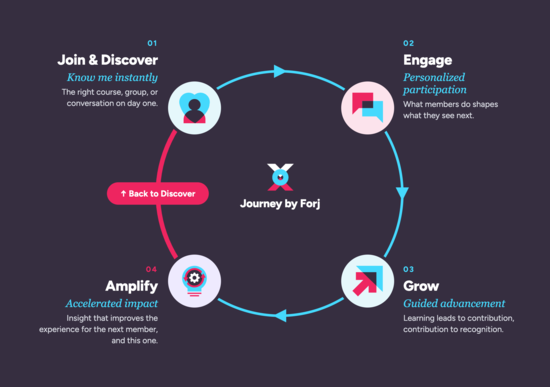
Amplify connects back to Discover. That link is what makes membership a relationship and not a transaction. Every course finished and every discussion joined makes the next step easier to find. The longer a member stays in the loop, the more valuable the loop gets, for them and for you.
Why this is hard
Delivering the loop is hard for two reasons. The first is the technology. A loop only works if the platform can see the whole thing.
If your learning platform doesn't know what a member did in the community, and your community doesn't know which courses they finished, each tool keeps restarting the relationship. You can put AI on top of either one, and it will still only know half the story. It will answer questions. It won't connect the dots for a new member who just asked a question in the community, and suggest a course that helps them keep learning about that topic. And it won't know who's best positioned to answer a question in the community, who should lead the next cohort, or who's ready to become a mentor. A platform focused on one piece doesn't know when to show up.
Most of us have lived some version of this. You see a specialist who doesn't have your lab results, so you carry them from office to office and repeat your history at every appointment. Every doctor is good at their job. None of them has the full picture, so you end up doing the work of connecting it. That's what a fragmented tech stack asks of members. Your members deserve an association that sees the whole chart.
The second reason is organizational. Most associations I talk to already get this. What stands in the way is usually internal. Membership and education teams have different priorities. Inertia sets in. The tech stack feels impossible to change. And for associations with corporate members, value gets measured differently. We'll dig into that friction in a separate post soon.
How we're building for it
As VP of Product Management at Forj, I work with our product and engineering teams to build the platform that makes the loop run effortlessly for associations. We're 100% focused on it, and it guides every decision we make with Journey by Forj, phase by phase.
The foundation: one platform, one intelligence layer. Forj Learn and Forj Connect share the same member record from the start. Members get one login and one hub, you get one AMS integration, and the intelligence layer reads across the whole experience. It understands what content means, not just which keywords it contains, and it learns from what each member actually does. That's how Journey by Forj knows when to show up, and with what, at every point in the member's journey.
Join & Discover: known from day one. A new member feels known before they've clicked anything, because the platform matches them on the job title, organization, and other details they shared at registration in Journey by Forj or synced from the AMS. Intelligent search finds what they need in the moment, built from content you already have. And when a member would rather ask, our AI discovery guide points them to relevant posts, members, courses, and resources across the platform.
Engage: guided when they don't ask. Recommendations draw on a member's real activity across learning and community, not a preferences form they filled out two years ago. A new member asks a question in a discussion, and the next course on that topic shows up for them. Members complete certificates and earn credits, attend community events, reply to discussion threads, all from a single experience.
Grow: everything an LMS should do, done well, and then some. CE credits, certificates, and compliance tracking work the way your members and accreditors expect. The difference is that learning doesn't end when the credit posts. Precursor courses build momentum before the annual meeting and turn into discussions during it. Afterward, cohorts can form around the interests that came out of sessions. A few days becomes weeks of connection, and a lasting sense of belonging.
Amplify: Insight you can act on. Forj Analyze shows how members move between learning and community, and AI helps surface the patterns behind it. See what’s working, act on it faster, and do more for every member, starting with the one in front of you.
What's next. We're excited about what's ahead. And soon, we'll bring AI Guides for learning and mentorship, and deeper personalization that reads the whole journey. The loop gets tighter from here.
What this means for your association
You don't need new technology to start thinking in loops. Start with three questions:
- Where does the loop break? Find the point where members stop. After the first course? After the annual meeting? That's your place to investigate.
- Are you measuring logins or loops? Logins tell you someone showed up. Loops tell you whether one experience led to the next, like a course that led to a discussion, or a discussion that led to a course.
- Can your systems see each other? If community activity and learning activity live in separate places, ask why. Then ask us. We'd love to show you what the loop looks like on one platform in a demo. And if you're curious about what's next for the member experience, ask for me.
Your members aren't asking for more technology. They're asking to be understood and guided, over and over, as their careers change. Build for the loop, and renewal takes care of itself.